Peoples of Sri Lanka
Burghers
Muslims, Moors and Malays
Sinhalese
Tamils
Veddah
One of the legends in the ancient chronicle known as
the Mahavamsa describes the people of the island before
the era of the great maritime trade. Since then, history
has made this country into a pot pourri of cultures
and ethnic groups, and mixed marriages have erased the
differences to such extent that, nowadays, it is impossible
to distinguish a Tamil from a Sinhalese on the basis
of physical appearance alone.
The population of Sri Lanka is currently around 19
million. Today the Sinhalese make up 74% of the total
population.
Sri Lanka's Tamils (18%) comprise the long settled
Tamils of the north and east (12.5%) and the migrant
workers of the tea plantations in the Hill Country (5.5%),
who settled in Sri Lanka from the late 19th Century
onwards. Even though the two communities have common
ancestry, they hardly ever intermingle.
The so-called "Moors" (a term inherited from the Portuguese),
Tamil-speaking Muslims of Indian-Arab descent, were
traders on the east coast and now constitute 7% of the
population.
A much smaller but highly distinct community is that
of the Burghers, numbering about 50,000 (0.25%).
The Dutch (mainly
members of the Dutch Reformed Church) and the Portuguese
intermarried with local people, and their descendents
were urban and ultimately English speaking.
There are similar numbers of Malays and smaller groups
of Kaffirs. The Malays are Muslims who were brought
by the Dutch from Java. The Kaffirs were brought by
the Portuguese from Mozambique and other parts of East
Africa as mercenaries.
The aboriginal inhabitants, the Veddha, have long since
been absorbed into the general melting pot of cultures.
Today may be only 200 or 300 still live in their ancestral
homelands and maintain a Stone Age lifestyle.
Origins and culture
Once upon a time, this term was used to describe the
Europeans - mainly the Dutch or the Portuguese - employed
in the service of the Dutch East India Company
(Vereenigde Oost-Indische Compagnie - VOC)
or free to set up in business on their own. With the
onset of British colonisation, in which they played
an important auxiliary role, this distinction disappeared.
The word "Burgher" began to be used to describe
anyone with European ancestors. During the same period,
they abandoned the Dutch language in favour of English
and monopolised the top posts in the colonial administration.
With the gaining of independence, when Sinhalese replaced
English as the official language, many of them chose
to emigrate, with Australia as a favourite destination.
Today these heirs to the colonial past number about
50,000, and openly describe themselves as a community
threatened with extinction.
Christianity in Sri Lanka
Christianity was introduced by the Portuguese,
although the discovery, at Anuradhapura, of a bas-relief
of a hand holding a cross may point to the presence
of a community of Syrian Christians as early as the
5th or 6th Centuries, following the example of the west
coast of India.
Unlike India, where Christian missionary work from
the late 18th Century was often carried out in spite
of colonial government rather than with its active support,
in Sri Lanka missionary activity enjoyed various forms
of state backing. One Sinhalese king, Dharmapala, was
converted, endowing the church, and even some high caste
families became Christian. When the Dutch evicted the
Portuguese they tried to suppress Roman Catholicism,
and the Dutch Reformed Church found some converts. Other
Protestant denominations followed the arrival of the
British, though not always with official support or
encouragement. Many of the churches remained dependent
on outside support.
Between the two World Wars, Christian influence in
the government was radically reduced. Denominational
schools lost their protection and special status, and
since the 1960s have had to come to terms with a completely
different role in Sri Lanka. Despite the limited influence
of Christianity in the central government of modern
Sri Lanka, Christianity is still practised by 8% of
the population and Roman Catholics account for 90% of
the island's Christians. Today Christians feature in
every social category of the island, from the poorest
(the fishermen on the west coast) to the most influential
(the middle classes in Colombo), and Christmas is a
public holiday in the national calendar.
Muslims,
Moors and Malays
|
|
Origins and culture
Arab traders first visited Sri Lanka many millennia
ago. By 1000 BC the pearl divers of Mantota (Mannar)
were Arabs and Persians, and the pearl necklace that
adorned the neck of the Queen of Sheba is said to have
come from here. In the time of the ancient Sinhalese
kings, Anuradhapura had an Arab street where stallions
were traded for spices. However, the main influx of
Arabs arrived after the rise of Islam, and large settlements
grew around Jaffna and all the way along the western
coast to Galle. The Muslims had a virtual monopoly on
trade on the island until the Portuguese arrived. The
Muslims sought protection from the King of Kandy, who
hid them in places like Gampola, Mawanella, Welimada
and Akuressa.
The British, busily classifying everything and everyone,
put the Moors, Tamil speaking Muslims of Indian-Arab
descent, in a separate category from the later Muslim
arrivals, the Malays and the Indian Muslims. The Malays
are descended from Malay regiments brought over by the
Dutch, while the Indian Muslims (Bohras and Memons -
a distinct Indian Shia sect hailing mainly from the
Kutch in northern Gujarat) were brought over by the
British themselves. Today's Muslim community, who are
the only community on the island to claim an identity
based on their religion alone, constitutes 7% of the
population, 95% of which are Moors.
Islam in Sri Lanka
Islam was brought to Sri Lanka by Arab traders. Long
before the followers of the Prophet Mohammad spread
the new religion of Islam Arabs had been trading across
the Indian Ocean with southwest India, the Maldives,
Sri Lanka and South East Asia. When the Arab world became
Muslim so the newly-converted Arab traders brought Islam
with them, and existing communities of Arab origin adopted
the new faith. However, numbers were also swelled by
conversions from both Buddhists and Hindus, and by immigrant
Muslims from south India who fled the Portuguese along
the west coast of India.
The great majority of the present day Muslim population
of Sri Lanka is Tamil speaking, although there are also
Muslims of Malay origin who speak a créole with
a strong Malaysian influence. Both in Kandy and in the
coastal districts Muslims have generally lived side
by side with Buddhists, often sharing common interests
against colonial powers. However, one of the means by
which Muslims maintained their identity was to refuse
to be drawn into colonial education. As a result, by
the end of the 19th Century the Muslims were among the
least educated groups. A Muslim lawyer, Siddi Lebbe,
helped to change attitudes and encourage participation
by Muslims
In 1915 there were major Sinhalese-Muslim riots, and
Muslims began a period of active collaboration with
the British, joining other minorities led by the Tamils
in the search for security and protection of their rights
against the Sinhalese. The Muslims have been particularly
anxious to maintain Muslim family law, and to gain concessions
on education. One of these is the teaching of Arabic
in government schools to Muslim children. Until 1974,
Muslims were unique among minorities in having the right
to choose which of three languages - Sinhala, Tamil
or English - would be their medium of instruction. Since
then a new category of Muslim schools has been set up,
allowing them to distance themselves from the Tamil
Hindu community, whose language most of them speak.
Cultural influences
National pride
Buddhism in Sri Lanka
Bhikkus, monasteries and temples
Belief in the stars
The Sinhala community today
Cultural influences
The Sinhalese have grown accustomed to taking on cultural
influences from visitors and traders. Their willing
acceptance of new ideas and people was further strengthened
by the large-scale emigration to the island from north
and south India. Many of the Sinhalese dynasties were
enriched by imported royal stock from Indian coastal
kingdoms. Their retinues, mercenaries and artisans provided
a wealth of knowledge and expertise which helped develop
the culture. Poetry, dance, drama, painting and sculpture
all thrived in such favourable circumstances.
National pride
The foreign domination of the past five centuries brought
other stimulating influences, many of which enriched
Sinhalese culture. The national dish, rice and curry,
for example, is derived from the Dutch, and the British
education system transferred well. However, all of this
was at a very high price. The level of exploitation
and the divisive methods used to control the populace
struck deep. Sinhalese nationalism is an understandable
but negative reaction to earlier suppression.
Despite being rooted in many cultures and enduring
500 years of foreign control, the Sinhalese have carried
through their turbulent history an intensely felt sense
of their unique identity, pointing to the purity of
the form of Buddhism practised on the island and on
the long history of their kings.
The Sinhalese are proud of their dynasty of kings reaching
back 2300 years, an unbroken chain of 167 monarchs,
who reigned in various parts of the island, ending with
the capture of Kandy in 1815. Throughout the centuries,
one feature that endured was the balance of influence
maintained between the rulers, the Buddhist monks and
village society.
Buddhism in Sri Lanka
Having enjoyed a golden age in the pre-medieval period,
Buddhism is still the dominant religion of Sri Lanka,
practised by 69% of the population. According to Article
9 of the Constitution, it is the State's duty to grant
it priority and to protect it, at the same time guaranteeing
freedom of worship to other religions.
One of the paradoxes of Sri Lanka is the fact that
it is simultaneously a preserver of the most orthodox
form of Buddhism, the Theravada ("Way of the
Elders"), yet responsible for leading it through
profound changes since the end of the 19th Century in
order to adapt it to the modern world.
Tradition associates the founding of Sri Lanka's first
kingdom with Devanampiya Tissa, who the Mahavamsa suggests
was converted to Buddhism by Mahinda, son of the great
Indian emperor Asoka, at Mihintale near Anuradhapura.
His decision to make Buddhism the official religion
in his state continues to shape Sri Lanka today. Devanampiya
Tissa also founded the Mahavihara ("Great Monastery")
in Anuradhapura, the first such Buddhist monastic community
in the country, which was to have a repeated decisive
influence on the land's political fate, and also oversaw
the chronicling of the country's history through the
Mahavamsa.
The Mahavamsa claims that Prince Vijaya and his followers
reached Sri Lanka on the day the Buddha gave up his
mortal body, signifying that the Sinhala race was anointed
with the task of preserving the teachings of the Buddha.
In fact the Mahavamsa states quite clearly that the
Buddha chose Sri Lanka as the country in which his doctrine
should survive in its original form. Even though they
were not converted to Buddhism until much later, the
Sinhala race and the Buddhist religion are inextricably
linked and remain so today.
Bhikkus, monasteries and
temples
The Buddhist monks or "bhikkus" are active in the local
community, as spiritual and family advisors. Some practise
the healing arts and astrology. In the contemporary
context, bhikkus participate in the economic and political
life of the country. There are now more than 6500 monasteries
in the country housing a community of around 20,000
monks.
Buddhist temples or monasteries are at the heart of
the Sinhala community, and are centres of teaching and
worship. The overall plan of a temple reflects its origins
as a place for monks to live and worship, and the design
follows a similar pattern throughout the country. The
sacred land on which the temple is built houses an array
of buildings and structures. A Bo tree (Ficus religiosa)
is the landmark, the tree under which the Buddha attained
Enlightenment. Of equal importance is the dagoba (relic
chamber), which is a symmetrical half-moon shaped solid
structure with a spire on the highest point. The image
chamber contains images of the Buddha and his disciples,
which in a modern context are artistic depictions of
the life of the Buddha in his various incarnations.
A simple preaching hall, which contains the belfry,
is situated in the same compound. The living quarters
of the monks are adjacent to the other structures. Temple
premises contain an image chamber of Hindu deities,
most giving credence to the fact that Buddhism and Hinduism
enjoy a spiritual unity.
Devotees have the opportunity to worship in the temple
premises at all times. Special days are marked by the
quarterly lunar cycle, when activities of worship within
the temple are intensified. On a rotating basis, the
meals for the monks are offered by the lay members of
the temple. Other offerings, which are placed around
each of the sacred structures, are flowers, incense,
oil lamps, camphor and fruit. Each offering has a specific
spiritual significance and is accompanied by audible
chants.
Support for the temple or, during the historical periods,
the monastery did not just extend to daily sustenance.
According to orthodox Buddhist belief, only members
of the Sangha - the order of the Buddhist monks - can
attain nirvana, the ultimate aim of Buddhist existence,
and thus avoid reincarnation after their death. Kings,
on the other hand, are subject to the eternal cycle
of death and rebirth. However, by giving generously
and performing other good deeds during their lifetime,
anyone can secure a favourable reincarnation. The Sinhalese
kings, and others who could afford it, thus generally
gave donations to the holy men of the Sangha. However,
since individual monks are not allowed to have personal
possessions, the monasteries amassed both land and goods,
and gradually became wealthy and powerful.
Belief in the stars
The Sinhalese take their superstitions very seriously.
Marriages, births and any major social event are planned
with great consideration to the advice of astrologers
and gurus, backed up by the whole pantheon of Hindu
gods and a lower order of demonic beings. Astrologists
prescribe the specific types of rituals and chart auspicious
occasions right down to days and times.
Every Sinhalese child has a horoscope based on the
time of birth. The horoscope is based on a mixture of
planetary influences, religion, legend and folklore.
The position of the stars and planets is carefully analysed
by an astrologer to determine the flow of the child's
early life, usually the first five years. Thereafter,
five-year horoscopes are cast in detail and predict
good times as well as bad, wealth, job and marriage
prospects and their effect on family members. For a
male child it may even lead him into the community of
bhikkus. If it is considered auspicious by the astrologer,
and the senior monk of the local temple agrees to undertake
training, parents of a young boy will then prepare him
for the monkhood. This invests blessed merit on the
mother and father, beneficial to their own spiritual
development.
Auspicious hours, days and months are carefully considered
before conducting any individual or family business
or social activity. Negative influences can be countered
by devotion to the Buddha, and propitiation ceremonies,
several thousand in number, can be prescribed to forestall
danger or earn favours at work or in any other area.
The ceremony consists of narratives, recitations, bell
ringing, drumming and dancing, complete with the appropriate
masks depicting the mischievous deity or demon - a ritual
condemned by Christian missionaries as devil worship.
Some ceremonies have been known to last for three days,
during which large amounts of food and drink are consumed!
The Sinhala community today
All Sinhalese people are bound together by their shared
love for parents, extended family, friends and children.
This is mutually expressed through gestures, body language,
looks and obeisance instead of words. The placing together
of the palms and fingers of both hands indicates a respectful
acknowledgement of another individual.
Buddhist monks have provided the spiritual glue which
maintains the cooperative spirit and serenity of village
life for over 2,000 years. To this day the Buddhist
temple doubles as a place of learning where young and
old are taught history and culture of the Sinhala race
and the Buddhist tenets of practical living.
The Sinhalese are renowned for their hospitality, as
well as their strong cultural heritage. Visitors to
the country, particularly those who have the time and
inclination to tour rural Sri Lanka and communicate
with the local people, will encounter a proud and traditional
but fun-loving race that genuinely treasures human contact.
The Jaffna Tamils
Up-country Tamils
Hinduism in Sri Lanka
Origins of the Liberation Tigers of
Tamil Ealam (LTTE)
The Jaffna Tamils
Sri Lankan Tamils fall into five groups. All but the
"up-country Tamils" have their roots in the
northern peninsula of Jaffna. Until the ceasefire and
initiation of peace talks in 2002, the Jaffna Peninsula
was under the control of the LTTE, which in the late
1970s had ethnically cleansed the area of non-Tamils
and Tamil-speaking Muslims.
Jaffna was a battleground until the December 2001 ceasefire
finally brought a semblance of normality to the region
and re-opened communications with the rest of the country.
This once large, peaceful community is now a settlement
of weary war-victims trying to re-establish community
life.
Up-country Tamils
About a third of the Tamils are, or have come from,
a labour force once conscripted mostly for the tea estates
and rubber plantations directly from south India. Some
families can trace their ancestry back nearly 200 years.
Today most of the previously indentured Tamils work
on the tea estates of the Hill Country.
In the Hill Country, the home of the Sri Lankan tea
industry, Tamil women tea-pickers, dressed in their
colourful saris and a combination of earrings, nose-rings,
bracelets, necklaces, anklets and toe-rings - always
gold and often studded with precious gems - scatter
the hillsides in all weathers. They collect the tea
leaves in wicker baskets (or, more recently, polythene
sacks), which are carried on their backs strapped to
their foreheads. The tea-pickers always carry a cane
stick, not as support but as a method of measuring the
height of the tea bush, which helps them select the
tea plants ready for picking. The average daily wage
of a tea-picker is Rs150, and she normally
picks in excess of 25kg of tea leaf buds - only the
top 2 or 3 newly produced leaves of each tea bush -
in a day.
Hinduism in Sri Lanka
Some Tamils credit their work ethic to the fact that
south India and the Jaffna Peninsula are riverless areas
of drought, which required creativity and persistence
to tame. Most also give credit to their Hinduism which
emphasises order (the caste system), disciplined behaviour
(instilled in childhood), correct behaviour (good karma)
and respect for all life (vegetarianism).
Hinduism, which is practised by 15% of the population,
is behind the Tamils tradition of quickly creating a
community wherever they find themselves, for the castes
ensure each person knows his role in that community.
A child may not go to school without breakfast and a
visit to the prayer-room. They may not enter the prayer-room
without bathing and putting on freshly laundered clothes.
They must eat with their right hand and wash with their
left. Prayer, cleanliness and routine become second
nature. Hindus have no required rites (as in the Catholic
religion), but individual households always develop
their own, as do the temples.
God is personified with infinite variety, or nearly.
There are said to be about 33 million gods in the Hindu
pantheon, including 1008 names for Shiva, 1000 for
Vishnu, and Kali is one of many mother images. Hindus
accept Jesus and the Buddha as avatars (gods in human
form), with Jesus depicted sitting on a fish.
Unlike strict Muslims, Hindus do not ostracise those
who convert to other religions. When Catholic missionaries
preached equality in God's eyes, many of the lower castes
took up the Christian faith. The missionaries benefited
from these hard-working devotees who did not consider
any job too menial, were eager for education and were
used to elaborate religious festivals. Over the years,
around 20% of Tamil Hindus have been converted to Christianity.
Origins of the Liberation
Tigers of Tamil Ealam (LTTE)
The civil war in Sri Lanka first surfaced in 1983 when
guerrillas - identified to begin with as "Jaffna
secessionists" - ambushed an army patrol, killing
an officer and 12 soldiers. The incident provoked a
Sinhalese backlash against Tamil civilians that resulted
in scenes of communal savagery, leading to the loss
of hundreds of Tamil lives and an exodus of over 150,000
Tamils to India. Out of this, the Tamil Tigers (correctly,
the Liberation Tigers of Tamil Ealam [LTTE]) emerged
under the leadership of Velupillai Prabhakaran, whose
involvement traces back to when, as a youngster, he
saw his uncle burnt alive by soldiers after riots triggered
by government moves to make Sinhalese the national language.
In 1971, when Prabhakaran was 17 years old, the government
pushed Sinhalese preferment policies a step further
by, for example, setting higher entry requirements for
Tamils wishing to enter university. Prabhakaran got
together with 30 like-minded Tamil teenagers and formed
the Tamil Tigers in 1976.
While their Sinhalese contemporaries
took inspiration from Anuradhapura, the young Tigers
could look back to their ancestral hold on the north,
and in particular to the pre-colonial independent Tamil
Kingdom of Jaffna.
Their idea of secession from Sinhalese-dominated Sri
Lanka and the creation of a separate Tamil state
("Ealam" - meaning precious land)
on the Jaffna Peninsula therefore had considerable historical
precedent, even if the economic viability of an independent
state in modern times would be, to ay the least, questionable.
From 1983 to 2009, the LTTE waged a deadly war against government
forces with the loss of at least 70,000 lives. During this period,
the LTTE can lay claim to
dubious "firsts" in war: the widespread use of suicide bombers and
the forced recruitment of child soldiers. However, both sides were involved
in clandestine acts during the three decades of the internal conflict including
disappearances and assassinations.
Finally, in May 2009, the government officially declared that the LTTE
were defeated after army forces overran the last patch of rebel-held
territory in the northeast. It was also reported that the LTTE rebel leader,
Velupillai Prabhakaran, was killed in the fighting, along with most of his
top military cadres. The de facto LTTE leadership in absentia stated that
the group would lay down its arms once and for all, so drawing to a close
one of the world's longest running and bloodiest conflicts.
Sri Lanka's first people
Who are the Veddah?
And how do the Veddah live
today?
Sri Lanka's first people
All of Sri Lanka's people have arrived on the island from
somewhere else, with the earliest settlers literally
walking over from India when sea levels were low enough
to join the mainland to Sri Lanka via the sand spit
known as Adam's Bridge. The Veddah are recognised as
the descendents of the earliest known inhabitants of
the island. These Stone Age hunter-gatherers were Sri
Lanka's "first people" and had more racial
affinity with African Bushmen or Australian Aborigines
than with any of the island's other Aryan settlers.
Alternatively there is a legend that the Veddah race
was actually founded by Prince Vijaya. The tale goes
that he married a woman of the Yaksa tribe who produced
a son and daughter. These two went to the Ratnapura
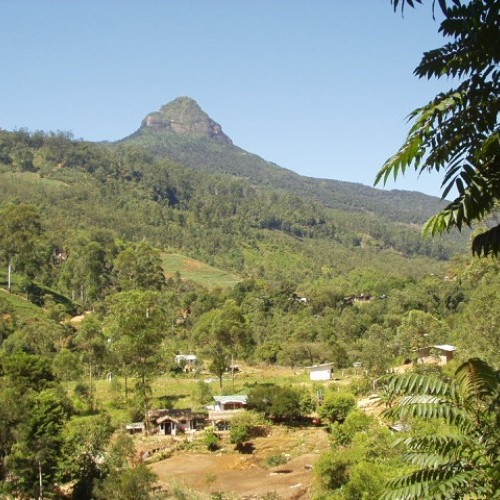
district and founded a community in the virgin forests
surrounding Adam's Peak, allegedly producing the Veddah
race. Whether or not this story has any foundation in
fact the Veddah and Sinhalese have certainly lived in
close proximity over many centuries, and intermarriage
has led to their decline in numbers.
Who are the Veddah?
The Buddhist chronicles of the Mahavamsa identify the
Veddah as Yaksa (natural spirit) and Naga (dragon) tribes,
who are described as spirits or ghosts. This is a tribute
to how little impact they made on the environment that
they inhabited.
The term Veddah comes from the Sanskrit word meaning
"hunter with bow and arrow", although they
prefer to call themselves the "the people of the
forest" or Vanniyalaetto. Their lush habitat allows
them to maintain a rich diet including venison, rabbit,
turtle, monitor lizard, wild boar and monkey.
Women are socially equal to men and descent passes
though the woman. In the wedding ceremony the bride
ties a bark rope, which she has twisted herself, around
the waist of her husband to be. Wives are faithful and
caring and are in charge of bringing up the children.
Traditionally, when a death occurred in a cave dwelling,
it was the practice to cover the body with dried leaves
and for the whole community to move to a new dwelling.
Perhaps as consolation for bereavement and for having
to move house, a widow was permitted to marry her husband's
brother.
And how do the Veddah live
today?
Modern day Veddah no longer live by their bow and arrow.
In fact their tools are more likely to be the chainsaw
and the gun. Since the 1960s these proud people's way
of life has been under siege, and the government has
been herding them into settlements without any consideration
for the traditional lifestyle. Far from happy, they
soon abandoned these so-called 'sanctuaries', which
they claimed were not big enough to sustain them, and
returned to their original habitations. They have recently
given up the worship of ancestral spirits and the tribal
social codes are sadly disappearing with their way of
life.
The two last remaining pockets of Veddah settlements
are in Dambana and Nilgala, in a mountainous region
in the Uva district. The aged chief, Tissahami, still
wages a debate against the government, claiming the
right of the Veddah to remain on ancestral land. Today,
maybe only 200 or 300 still live in their ancestral
homelands and maintain a Stone Age lifestyle.
|