Sigiriya
Then
Kasyapa (473-91),
who had not been made heir to the throne,
murdered his father, King Dhatusena, and established
his capital in the rock fortress at Sigiriya. As was
common practice in such circumstances, his half-brother,
Moggallana (491-508), the rightful heir to the throne,
ran off to the mainland to raise an army and take the
throne for himself. His negotiations took 18 years,
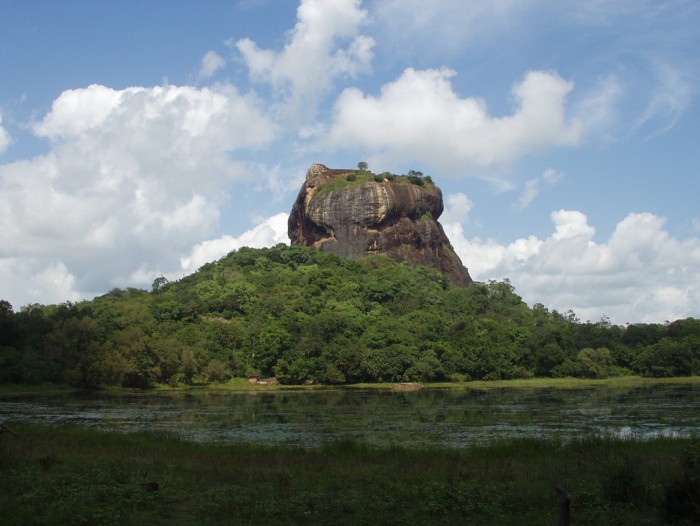
and in the meantime Kasyapa built an impregnable fortress
on a 200-metre high rock that, even today, towers over the
forest below.
While there was no sign of
Moggallana, Kasyapa indulged himself
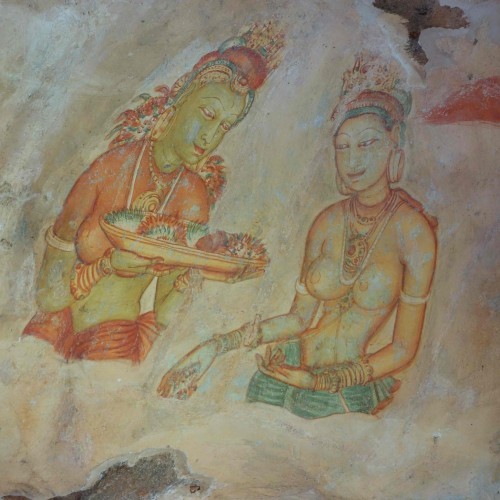
and added a water garden and a gallery of 500 topless
apsaras (celestial nymphs) so beguiling that generations
of graffiti artists have poured out their hearts in
verse. However, Moggallana did finally return, and after
watching Kasyapa take his own life on the battlefield,
he returned the capital to Anuradhapura with the help
of his Chola mercenaries.
and
now
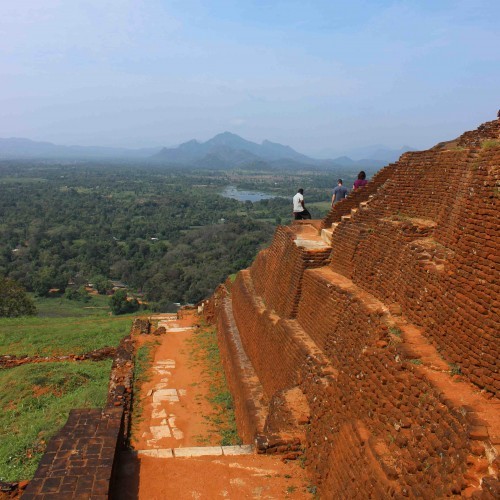
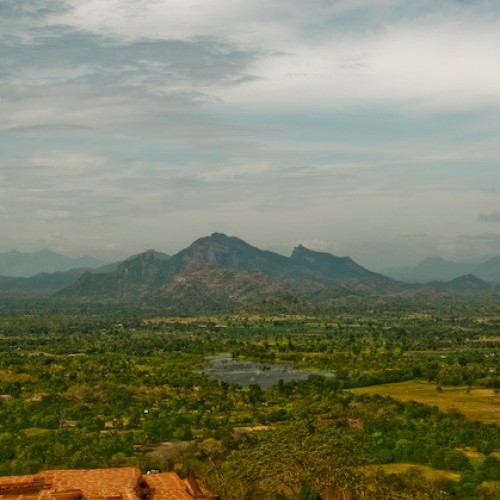
The vast flat-topped "Lion Rock" or Sigiriya stands starkly
above the surrounding countryside of the central forest
with magnificent views over the Dry Zone and south to
the Central Highlands. It was an exceptional natural
site for a fortress, which gets its name from the lions
which were believed to occupy the caves. In addition
to the remains of the rock fortress with its palaces
and famous frescoes, there are extensive grounds, including
water gardens, at the base of the rock and the site
is enclosed by an outer moat containing water. Sigiriya
was designated a World Heritage Site in 1982.
For many visitors, this impressive
site is their favourite in the whole of Sri Lanka. There
are stunning views from the top, which is best ascended
at first light when it is cooler and less busy than
later on in the day.
The principal areas of the site are:
Fresco Gallery
Lion's Platform
Mirror Wall
The Gardens of Sigiriya
The Palace on the Summit
Most of the principal sites of interest
can be visited in a 3-hour tour from Sigiriya.
Fascinating
amongst the pictorial art of Sigiriya are the glamorously
sensuous paintings of feminine beauty. This was a daring
endeavour by Kasyapa, since Sri Lankan art was solely
inspired by Buddhism at that time, a religion that preaches
the cessation of lust to achieve everlasting happiness.
Of
the original 500 or so frescoes, which vie with those
in Ajanta in western India, only
21 remain. They are remarkably well preserved, as they
are protected from the elements in a niche in the rock
wall. In the style of Ajanta, the first drawing was
done on wet plaster and then painted with red, yellow,
green and black. Slightly smaller than life-size, they
are seen in three-quarter profile. Their beauty can
be best enjoyed when you examine the frescoes in detail,
since there is a striking diversity in mood and personality,
face and body, clothes and make up.
What
were the real reasons for these paintings at Sigiriya?
Whilst some have portrayed these figures as ladies in
Kasyapa's royal court in a devotional procession to
the nearby shrine at Pidurangala, or representations
of clouds and lightning moving about the peak of Mount
Kailasa, the current consensus is that the figures are
"portraits" of apsaras (celestial nymphs) and attendants
above clouds - offering flowers, scattering petals or
bathing - in keeping with south Indian traditions.
Sigiriya rock fortress has a half-way stage
at its northern end, where a large plateau offers rest
and stalls selling refreshments.
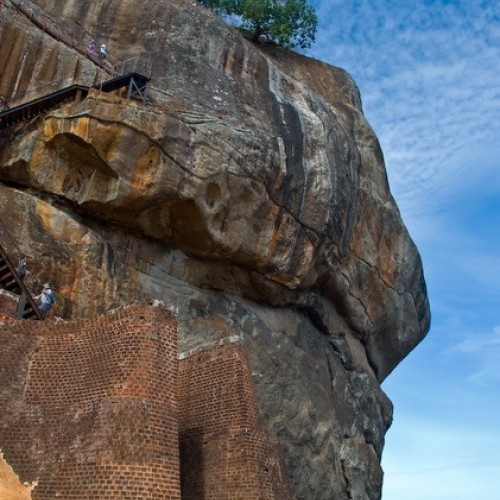
The
two enormous lion's paws are all that remains of the
giant beast that gave the rock its name, for, incredible
though it may seem, the entire rock was transformed
into a mountainous lion by the addition of brick-built
foreparts, stuccoed and presumably painted. There were
originally steps leading between the paws and into the
lion's mouth. The sheer audacity of the idea is breathtaking
and the surviving paws themselves are of a scale to
make you shudder. They are expressively moulded and
intimidating in size. By building this sculpture Kasyapa
was certainly trying to intimidate his enemies, but
at the same time he was also claiming his kingship over
the "lion race" - the Sinhalese.
On the way to the Lion's Platform
and beneath the gallery containing the frescoes is the
Mirror Wall. This highly polished plaster wall, believed
to have been coated with polished lime, egg white and
honey, still has a reflective sheen, but only in a few
areas not damaged by ancient graffiti.
Scribbled on the surface of
the Mirror Wall are nearly 1500 pieces of prose or
poetry composed by the ancient visitors who flocked
to Sigiriya from all over the island. These poems, which
testify to the sightseers' appreciation of art and beauty,
were mostly written between the 7th and 11th Centuries
and are said to be Sri Lanka's oldest graffiti. Most
of the graffiti is written in Sinhalese, but some of
the poems are written in Sanskrit and Tamil.
The Gardens of Sigiriya are a unique
achievement, not only because of their complex hydraulics,
but also because they are so well preserved, their antiquity
preceded only by the ancient gardens of the Romans such
as the gardens of Pompeii and Herculaneum, and the imperial
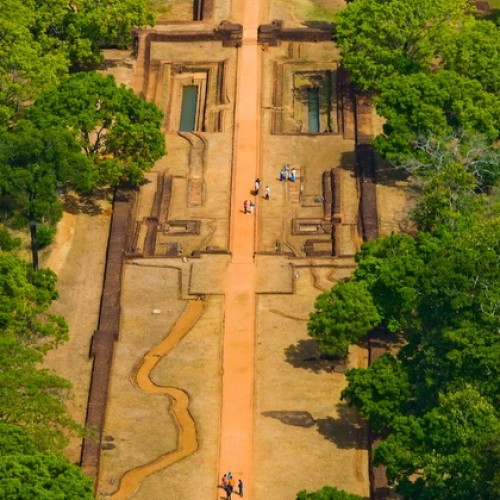
gardens of Hadrian at Tivoli. The Water Gardens,
Boulder Gardens and Terraced Gardens make a harmonious
picture on a grand scale.
The
Water Gardens, which are still well preserved, are
a combination of the Hanging Gardens of Babylon, the
boulder gardens of China or Japan, and the water gardens
of ancient Rome. The Terraced Gardens flow down to the
Boulder Gardens and then to the geometrically laid out
Water Gardens in the western precinct. With running
water and fountains, pools and ponds, aquatic flowers
and birds with gorgeous plumage, tropical trees with
bright blossoms, these royal gardens remain a place
of serenity for mind and body.
The entire Water Gardens are in a
walled enclosure. With winding waterways, shallow reflecting
pools, corbelled water courses, and marbled floors,
and an intricate layout of tiled buildings, these gardens
are an ideal location to get a glimpse of the splendour
of Sigiriya.
Four L-shaped water pools near the
entrance to the gardens were almost certainly used as
bathing pools, since they have polished walls, flights
of steps and surrounding terraces. Reinforcing the symmetrical
layout, towards the Lion Rock, are four large islands
surrounded by moats located either side of the walkway.
"Cool Water Palaces" once occupied the two inner islands.
Abutting
these islands are fountains fed by waters from the artificial
Sigiriya Lake under gravitational pressure. Using symmetrically
perforated limestone plates to fashion their spouts,
these fountains operate in rainy weather even today.
Another remarkable pool, octagonal in shape, is hidden
from the main western walkway, and adds further amazement.
Surrounded by a wide terrace following its shape, the
pool is sheltered by a gigantic boulder almost six storeys
high, a bold arrangement of water harmonising rock,
with the pond located at the very point of transition
from the Water Gardens to the Boulder Gardens.
The
Boulder Gardens are in sharp contrast with the geometrical
symmetry of the bordering water gardens, yet the fusion
of the two gardens is remarkable. With similarities
to the boulder gardens of China and Japan, picturesque
boulders of varying size grace this area. Linked together
by winding passages, with boulder arches and limestone
stairways, edifices of little known character stood
on almost every boulder, whilst there were rock caves
beneath them. The intriguing honeycombed holes on these
boulders are nothing more than footings for brick and
timber buildings.
Audience Hall Rock and Cistern Rock
Equally fascinating are the rock carvings on the boulders,
especially those on an enormous split boulder. On the
fallen half, known as the Audience Hall Rock, is a 5-metre
long carved stone throne facing a levelled square. On
the standing half is a water reservoir, dug into the
rock, hence its name, the Cistern Rock.
Cobra Hood Cave
Another boulder of
interest is the picturesque Cobra Hood Cave, so named
because of its shape. Buddhist monks from as early as
the 3rd Century BC used this cave, though its painted
ceiling has been dated to the period of Kasyapa (5th
Century AD), who founded the rock fortress and surrounding
gardens.
Preaching Rock
Preaching Rock,
located on the side of the octagonal pond, is also impressive.
Its tiered platforms are believed to have been used
by orating monks. Clearly, the Boulder Gardens, with
its many caves, had been used as a monastery long before
Kasyapa incorporated it into his royal pleasure gardens.
Merging with the Boulder Gardens are the Terraced Gardens,
with each terrace rising above the other, similar to
the Hanging Gardens of Babylon. Tumbledown walls now
retain the mounting earth. Impressive brick-built staircases
with limestone steps traverse the terraces, providing
access to the uppermost terrace and onwards to the Sigiriya
Rock itself. The once magnificent Sigiriya Wewa could
also be reached from here. This lake is the main source
of water for the gardens and, as seen today, it is only
a fraction of its original size.
It
is difficult to imagine the maze of pipe work buried
beneath your feet. This intricate network covering the
entire Sigiriya complex, with control valves, ring mains,
manholes, silt traps, by-pass conduits and the like,
is comparable to modern networks. Stone drains encased
in clay carried water horizontally, and down-pipes,
made of two stone semi-circular sections held together
by metal straps, carried water vertically. You will
also see many open channels cut into the rock itself
used for collecting water drained from the summit. Excess
water overflowed to irrigate the lower areas of Sigiriya.
Conservation was paramount in the minds of the designers
of Sigiriya.
Emerging
from the jaws of the regal lion, now destroyed by the
torrential downpours and gusty winds it has suffered
over 15 centuries, you climb a staircase clinging to
the side of the Lion Rock and arrive at the summit and
the ruins of the palace.
A
unique palace, with layout and ground plan clearly visible,
it is strikingly different to those found in Anuradhapura
and Polonnaruwa. Whilst the inner palace occupies the
lower eastern sections, and the palace gardens cover
the south, they all converge on a large and lovely rock-cut
pool, probably used for water storage. There would have
been the granite throne, dancing terraces, a small pool
fed by rain water, drinking water tanks, sleeping quarters
for the concubines, a small flower garden and precariously
positioned platforms for guards.
There
are still the foundations to the king's audience chamber
and his anteroom. Once again, there is a huge throne
in a semicircle where his advisors would sit - justice
was swift and often brutal. Immediately below the audience
chamber was another granite slab, which was the place
of execution. Much of the construction is in brick,
faced with lime plaster but there are sections built
with limestone slabs which would have been carried up.
The upper structures which have disappeared were probably
wooden.
With thousands of marbled steps and
walkways, this 1.2-hectare site is simply stunning and
the panoramic views breathtaking.
|