Polonnaruwa
Then
Polonnaruwa
was the medieval capital of Sri Lanka between the 11th
and 13th Centuries. Strategically, it commanded all
the crossings over the Mahaweli River, Sri Lanka's longest,
guarding the increasingly powerful southern province
of Ruhuna. In 993 AD, the Cholas, invaders from southern
India, looted and burnt Anuradhapura and used Polonnaruwa
as their military base for 77 years, resulting in an
interesting blend of south Indian Hindu culture and
Sinhalese Buddhist art and architecture.
The valiant Vijayabahu I, who defeated the Cholas in 1073,
devoted his long reign to the development of irrigation
and Buddhism. Civil war followed his death and in 1161
Parakramabahu I captured Polonnaruwa and assumed control
of the whole island. Regarded as being the last great
king of Sri Lanka, Parakramabahu's greatest contribution
was his protection of the Buddhist faith. Nissanka Malla,
his nephew and successor, also embellished the city
with many new buildings. In its prime, the city was
enclosed by three concentric walls, and was made attractive
with parks and gardens. However, around 1293, Polonnaruwa
returned to the jungle after the capital city migrated
southwards.
and
now
Polonnaruwa
owes much of its glory to the artistic conception of
King Parakramabahu I, who planned the city as an expression
and statement of imperial power. Its great artificial
lake provides cooling breezes through the city, water
for irrigation and at the same time, defence along its
entire western side. The bund is over 14 km long and
1 m high, and the tank irrigates over 90 sq km of paddy
fields. Fed by a 40-km long canal and a link from the
Giritale tank, it is named after its imperial designer,
the Parakrama Samudra (Topa Wewa). In 1988, it was designated
a World Heritage Site.
Today, Polonnaruwa is a compact, walled
city with many significant and well-preserved sites,
particularly if you are interested in the historical,
cultural, artistic and architectural heritage of Sri
Lanka.
The principal areas of interest are:
Ancient City
Northern Monuments
Royal Citadel Group
Southern Group
Most of the principal sites of interest
can be visited in a half day tour from Polonnaruwa.
Quadrangle
The centrepiece of the ancient city, the Dalada Maluwa
(the Terrace of the Tooth Relic), was a sacred precinct
containing 12 magnificent buildings, the construction
of which was connected with the reigning kings. After
the relic of the Sacred Tooth became the main symbol
of royal dignity, the rulers each made sure they built
their own Tooth Temple. Today it is known as the (Sacred)
Quadrangle:
Atadage
The
"House of the Eight Relics" was the first Tooth Temple
built by Vijayabahu in the 11th Century and on which
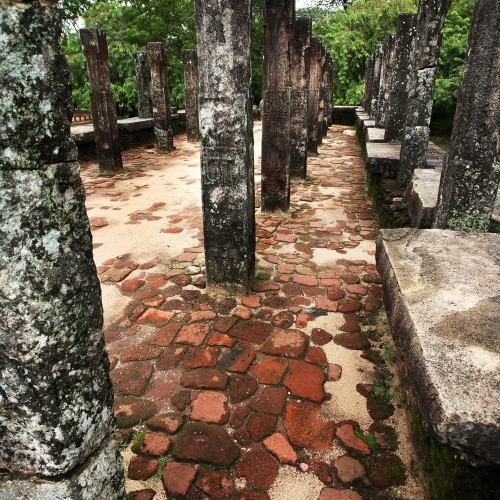
the current one in Kandy is modelled. A neat plantation
of 54 stone columns, some of them intricately carved,
others embedded in brickwork, would have supported a
timber upper floor in which the relic was kept. An image
of the standing Buddha almost 3 m high stands among
the columns. A stele nearby has reminders of the supervisory
role of a regiment of Tamils.
Gal Pota
The "Book of Stone" is
an enormous stone slab that has glowing inscriptions
praising the work of Nissanka Malla, leaving no doubt
who the author might be. Ola leaf parchment was the
usual medium fro writing, but these rectangular leaves
were small and easily overlooked, so the vainglorious
King had this giant petrified version, 8 m long by 4
m wide and weighing 25 tonnes, dragged all the way from
Mihintale, 100 km away.
Hatadage
The
"House of 60 Relics" resembles the Atadage in plan as
well as in name, and it was built for the same purpose,
when the protection of the Tooth Relic became a symbol
of royal power. Its thick stone walls that still contain
three Buddha images are inscribed with Nissanka Malla's
name, but it seems more likely that the construction
of this strongbox temple was the work of Parakramabahu,
who had taken the Tooth Relic back from the lords of
Ruhuna.
Latha-Mandapaya
The
"Flower-scroll Hall", attributed to
Nissanka Malla, was probably built for the chanting
of protective religious texts. The miniscule
central dagoba with a truncated top was used to house
the relic during the ceremonies. The ornamental stone
pillars which surround the dagoba are representative
of lotus buds on stalks and are part of a "baroque"
period in Sinhalese art in which an austerity of style
gave way to heavy ornamentation.
Sathmahal
Pasada
The
"Seven Storey Edifice" is of a simple stepped design,
but is deeply perplexing to historians. Ancient chronicles
make no mention of it, and archaeologists are stumped
as to its origin. Nothing else like it is seen on the
island and it looks like a Babylonian ziggurat, which
was possibly a short-lived variation of the stupa, reminiscent
of Chinese or Nepalese pagodas, or Cambodian prasats.
It has also been suggested that Laotian monks erected
it as a memorial. Each floor has a niche on each face
to contain figures, remnants of which survive.
Thuparamaya
The
well preserved Thuparamaya is an image house built for
the worship of the Buddha. It
is in a style of the stunningly original form of architecture
that flowered at Polonnaruwa, a fusion of Indian and
Sinhalese Buddhist architecture. These barrel-vaulted
and domed buildings had brick walls of great thickness,
stuccoed and painted with figures and architectural
subjects. The roof of the Thuparamaya is intact and
several images are still in place inside. This buildings
façade, with its niches and pilasters, garlanded
with a frieze of elephants and buildings, was clearly
influenced by southern Indian art.
Vatadage
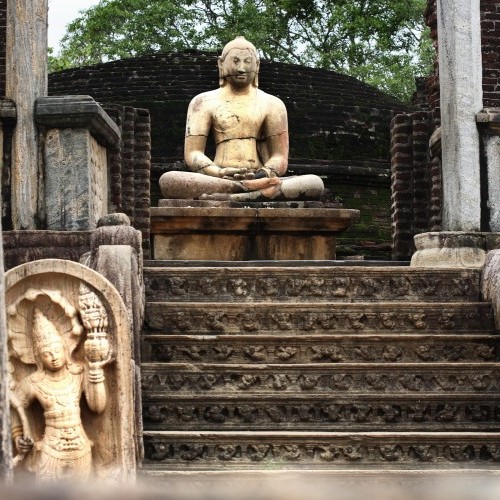
The "Hall of the Relic"
is a circular building with a dagoba on concentric terraces
with sculptured railings, the largest with a diameter
of 18 m.
A superbly planned and executed 12th Century masterpiece
attributed to Nissanka Malla, the Vatadage has modest
proportions but remarkably graceful lines. It was almost
certainly intended to house the Tooth Relic. There are
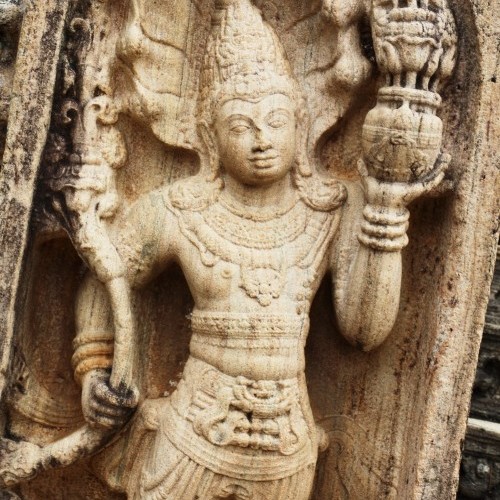
impressive cobra-king guard stones at the entrances
of the second terrace and wing stones with makaras enclosing
lion figures. The moonstone to the north entrance of
the top terrace is superb. The dagoba at the centre
has four Buddha statues (some damaged), which have the
unique characteristic of being portrayed with neither
curls in their hair nor folds in their clothes.
Shiva Devale No. 1
The
Citadel has only one entrance from the north. Facing
this is the Shiva Devale No. 1, a Hindu temple (one
of the many Shiva and Vishnu temples here) built in
about 1200 AD. An example of the Dravidian Indian architectural
style, it shows exceptional stone carving, and despite
its modest size it is ebullient rather than serene.
Some superb bronzes were found here and are now exhibited
at the Colombo Museum.
Rankot
Vihara
The
perfection of the spire and the clarity of the statues
round the drum of Rankot Vihara
or "Golden Pinnacle", the largest dagoba in Polonnaruwa
with a height of 55 m, are a tribute to the artistic
perception of its master builder, Nissalanka Malla.
Founded in the 12th Century by one of the queens of
Parakramabahu, it was completed by Nissalanka Malla,
who had himself portrayed on an inscription, admiring
the building work!
Alahana
Pirivena
The "Monastery of the Cremations" owes its name to the
fact that it was founded by Parakramabahu I on the site
of an ancient cemetery. The site contains the Baddhasima Pasada,
Lankatilaka and Kiri Vihara.
Baddhasima Pasada
The imposing structure of the Baddhasima Pasada (Assembly
Hall), with its central platform, was used for reciting
the common rules of discipline of the vinaya on poya
nights. There was a reliquary in the centre of the terrace
around which sat four monks on stone thrones. The eight
stones marking the edge of the complex suggest that
its use was reserved strictly for the monks. On the
west side there is a stepped pool in the shape of an
inverted pyramid.
Lankatilaka
The impressive walls of Lankatilaka ("Jewel of Lanka")
image house reach a height of 16 m, and the unique brickwork
is of extraordinary variety. Inside the shrine stands
the headless statue of the Buddha, and the interior
walls are adorned with excellent murals. The outside
walls are divided into five floors, and adorned with
very impressive bas-reliefs of architectural subjects,
which give an indication of the type of domed roof it
would have had. Inside is a single tall space, which
is still very impressive, though open to the sky.
The design illustrates the development
of thinking underlying the massive building, for it
marks a movement away from the abstract form of the
dagoba to a much more personalised faith in the Buddha
in human form. The building is essentially a shrine,
built to focus the attention of the worshippers on the
13-metre high statue of the Buddha at the end of the nave.
Though built of brick and covered in stucco, the overall
design of the building shows strong Tamil influence.
Kiri Vihara
The
"milk-white" Kiri Vihara, so named because of its unspoilt
white plaster work when it was first discovered, is
the best preserved unrestored dagoba on the island.
The plasterwork is intact although the whitewash is
only visible in places, such as around the relic box.
Gal Vihara
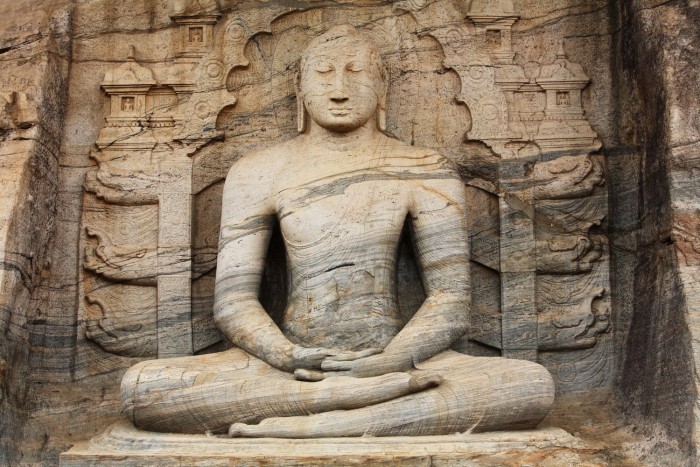
The sublime "Temple of the Rock" belonged to the northern
monastery, another building founded by Parakramabahu.
Its four rock-cut statues of the Buddha are the high
point of Sinhalese medieval carving and it is rightly
regarded as one of the foremost attractions of Sri Lanka,
which is best seen in the early morning light. Unfortunately,
in a bid to reduce the effect of weathering caused by acid rain,
Gal Vihara now has a protective canopy oversailing it, which,
to say the least, detracts from the serene surroundings.
Out
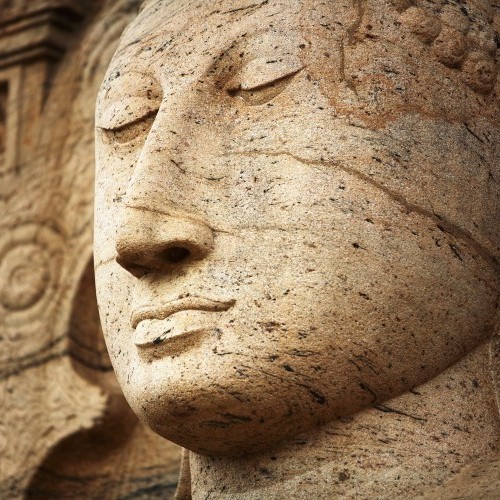
of the cliff-face of granite, unknown artists carved
three figures of the Buddha and a chapel. The earliest
figure, which is 7 m high, shows the Buddha standing
on a lotus plinth in the "blessing posture", his arms
folded and his eyes half closed. The sculptor was working
with material that to some extent dictated the output,
so that dark strata in the rock sweep contour lines
across the delicately carved features of the face.
Later
this image was joined by the other figures. The seated
Buddha meditates cross-legged against an interesting
relief of buildings, another hint of how Polonnaruwa's
temples originally looked. The rock-cut chapel alongside
contains a further seated Buddha surrounded by attendants
waving fly whisks and other decorations showing traces
of paint. At the time of Parakramabahu, the statues
were painted and each one stood in its own image house,
as is indicated by the holes for the beams that can
be seen in the rock and surrounding walls.
The
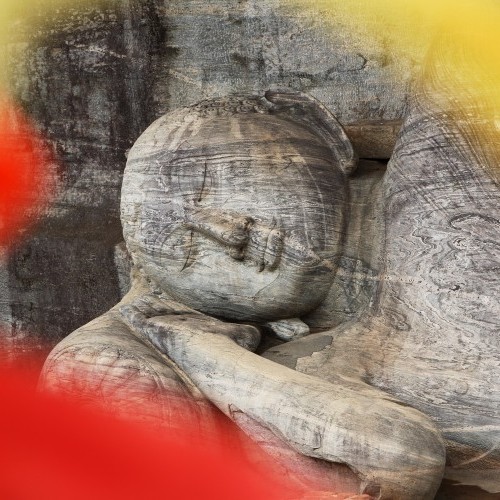
largest figure is a 14-metre long reclining Buddha of such
beauty that it inspired hundreds of years of Sinhalese
art, but was never matched. Here the variations in the
colour of the rock appear as a veil of ripples washing
over the figure of the Buddha as he slips into Parinirvana
(rather than death), indicated by the way the higher
foot is shown slightly withdrawn. The reverent tenderness
with which every detail - including the serene expression
of the Buddha, the decorated pillow with a depression
in it and the folds of the garment - has been carved
with such graceful skill makes it easy to forget how
difficult the sculptor's task must have been.
Vejayanta
Pasada
The
administrative centre of Parakramabahu's capital was
surrounded by walls that can still be clearly seen today.
Within them the Vejayanta Pasada, the royal palace of
Parakramabahu, is still impressive, and the massive
brick walls of the main hall stand amidst the ruins
of about 40 intercommunicating rooms. The palace and
its courtyard were surrounded by walls which were further
protected by an outer wall. According to ancient records,
the palace rose to seven storeys and contained 1000
rooms, but since the upper floors were wooden no trace
of them remains.
Audience
Hall
The Audience Hall (sometimes
called the Council Chamber) is immediately east of the
royal palace and contains exquisite stone carvings. The
stone base of this building is engraved with some perfectly
preserved bas-relief friezes, among them a procession
of placid, life-like elephants, seated lions posing
majestically, and a frenzied dance of gana (dwarves).
The entrance has two flights of steps with decorative
moonstones flanked by makaras (mythical dragon-like
beasts), which leads up to a platform where two octagonal
granite columns are still standing. Each one is delicately
engraved with figures of dwarves, lotus petals and flowers,
and vases of plenty. At the southern end is the massive
"Lion Throne".
Kumara
Pokuna
A passage in the ramparts of the Citadel leads to the
stepped Kumara Pokuna or Royal Bathing Pool, all that
remains of the water gardens that once adorned the royal
palace. The water from the tank flows into the nearby
canal through gargoyles in the form of makara.
Statue
of Parakramabahu/Agastaya
On entering the wooded section of the Southern Group,
you will first see a huge 12th Century rock sculpture
of great quality. A barefoot figure, clad only in a
sarong, steps forward out of the wall of rock from which
it is carved. His broad face, with its beard and walrus
moustache, has a look of seriousness softened by spirituality,
as he holds a sacred manuscript from which he appears
to be reading aloud.
The
subject of the statue is a matter of great debate. A
Shivaite rishi (Indian religious teacher) named Agastaya
is the most probable candidate, which would coincide
well with the theories about the function of the Pothgul
Vihara. However, it has also been suggested that it
is a representation of the city's great hero, Parakramabahu
I and is a memorial to him, since the palm leaf manuscript
he holds in his hand may be the "Book of Law", or "the
burden of royalty" in the shape of a rope. Whoever it
represents, this 3.5-metre high figure is a masterpiece.
Pothgul Vihara
The
restored Pothgul Vihara, a gedige (image house), consists
of four small dagobas surrounding a circular brick building
on the central platform. The acoustics of this enigmatic
building are excellent, even without the corbelled roof
that it would have had when it was built. This has lead
to the suggestion that it was a lecture theatre where
the tenets of Buddhism were read aloud. Alternatively,
the 5-metre thick walled building may have housed a library.
|