Powered By Optimal Payments

Ancient Cities

Aluvihara
Anuradhapura
Dambulla
Mihintale
Nalanda
Polonnaruwa
Sigiriya

Mihintale

Then…

The history of Mihintale is the history of Sri Lankan Buddhism, which begins with the story of the Indian missionary and Buddhist monk, Mahinda, since this is, literally, Mahinda's Mountain. This was where King Devanampiya Tissa was converted to Buddhism by Mahinda in 243 BC. The legend tells how King Tissa was chasing a stag during a hunting expedition. The stag reached Mihintale and fled up the hillside followed by the King until he reached a place surrounded by hills, where the animal disappeared and the frustrated King was astonished to find a gentle person who spoke to him about the Buddha's teachings. It was Mahinda, Asoka's son, who had come to preach Buddhism. Mahinda tested the King, found him worthy and was able to convert the King to Buddhism with 40,000 followers. Buddhism soon overwhelmed the island, embraced with fervour by the Sinhalese people, whilst in India it declined. The Buddha himself sanctified this mountain three centuries before Mahinda's visit.

…and now

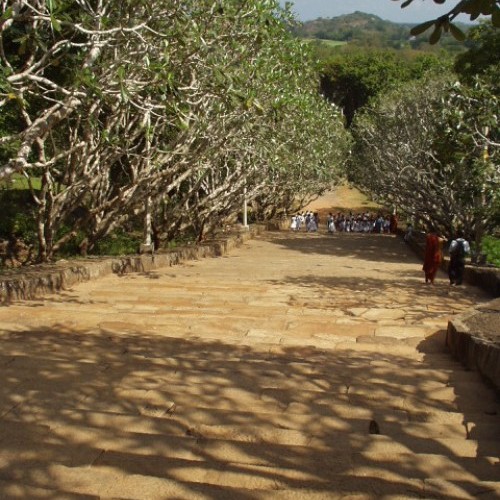
Mihintale is one of the 16 most important pilgrimage destinations in the country, with the Poson (June) full moon festival in particular attracting thousands of pilgrims. The three flights of granite steps to the top, totalling about 1840, take the pilgrim through the shadows of the spreading temple trees to the summit. They were built in the reign of Bhathika Abhaya (22-7 BC), but a later paved road provides a short cut. The first flight of steps is wide and shallow. The climb is sufficient to require regular deep breaths and a meditative pace.

Why visit Mihintale?

Regardless of your beliefs, the beautiful shrines, stupas, caves and, above all, the wondrous setting, make Mihintale unforgettable. Looking over the flatlands around Anuradhapura from Mihintale is a wonderful opportunity to get to know the countryside of the central north, where life still depends on the precious water in the pools and channels built by the kings of long ago.

The principal sites of interest include:
Ancient Medicine
Kantaka Chetiya
Off the Beaten Track
The Ascent
To the Summit

Most of the principal sites of interest can be visited in a 3-hour tour from Anuradhapura.

Ancient Medicine

At the foot of the mountain and before the first flight of steps are spread the ruins of a hospital (Vejja Sala), which dates back to the 3rd Century AD, some 400 years before the earliest recorded hospital in Europe. Among the remnants of walls and pillars are monolithic basins for bathing the sick, known as bat oruwa or "medicinal boats". They are hewn from a single rock, but they have a particularly gripping sculptural quality. The internal cavity is shaped to immerse a recumbent body without wasting precious herbal oils. Stones used for grinding medicinal herbs unearthed here can be seen at the museum, along with medicine jars whose blue glaze indicates that a link must have existed between Persia and the island.

Kantaka Chetiya

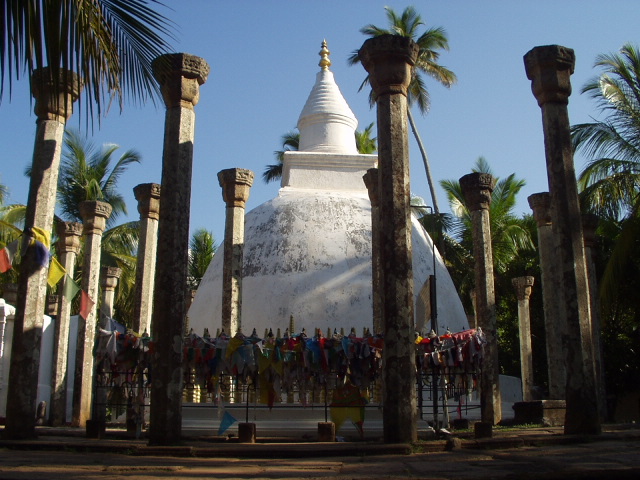
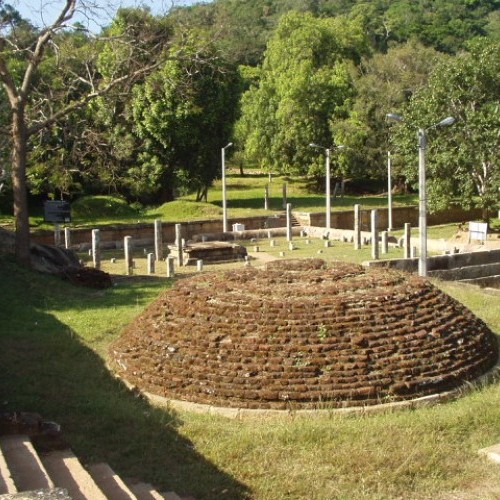
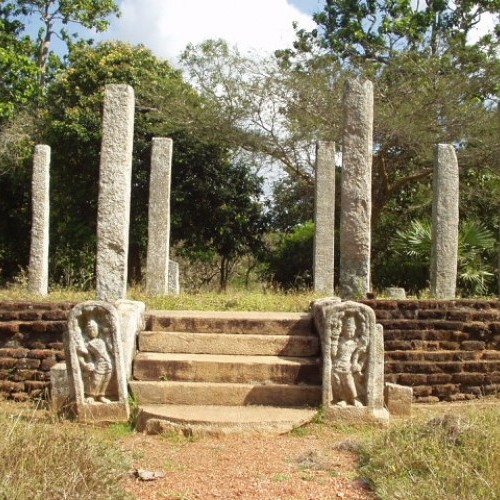
At the end of the first flight of steps is the 2nd Century BC Kantaka Chetiya, one of the earliest religious monuments on the island, excavated in 1934. The 130-metre base consists of three giant steps of dressed stone, a characteristic of Sinhalese stupas. Above them the dome has worn down to resemble a heap of masonry, reaching 12 m in height. It would originally have been much more impressive at over 30 m high.

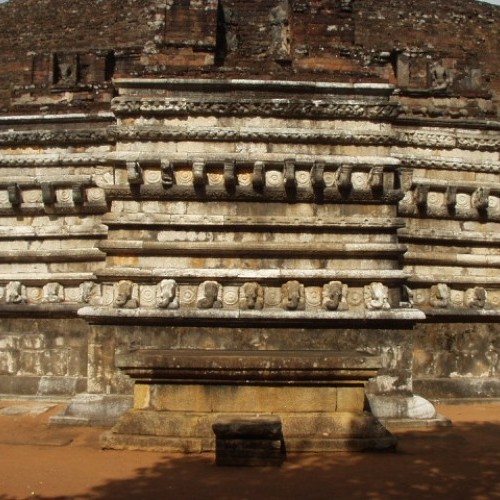
The highlights of the building are the four ornamental façades called vahalkadas facing the cardinal points. The eastern façade is the best preserved, with horizontal rows of carvings separated by strips of plain stone. There are beautiful friezes of dwarfs and elephants among the symbolic patterns, and on either side the wall is finished off with a tall carved pillar holding rather weathered lions aloft. The south façade also has some very ornate pillars carved with symbolic animals and plants. There is also a small relief figure of a naga, which is one of the earliest figure sculptures on the island.

South of the ancient stupa is something even older. On a rock shelter that would have been inhabited by Buddhist monks in the 3rd Century BC can be found an inscription in large Brahmi characters, the forerunner to the Pali script. These rock shelters are perched on the edge of a sheer cliff face where the resident monks would sit on narrow ledges and meditate. The Brahmi inscriptions below the drainage ledges bear the names, titles and occupations of the caves' donors. It was considered meritorious to make such hermit dwellings available to the arahants, the holy men, and 68 of them have been found in the Mihintale area.

Off the Beaten Track

On a high peak are the ruins of Et Vihara, the "Stupa of the Elephant". It has a panoramic view of the sacred valley on the one side and of Kaludiya Pokuna ("Pond of the Black Water") on the other. This artificial pond at the foot of the western slope of Mihintale served a monastery of the 10th or 11th Centuries. It is a very beautiful and peaceful spot.

Near the base of the westernmost hill is Indikatuseya dagoba ("Stupa of the Needle"). This site caused great excitement among Buddhist scholars when Sanskrit texts belonging to the Mahayana school were found here. They had been transcribed into Sinhala characters and inscribed on copper plaques in the 8th or 9th Century.

The Ascent

The second flight of steps leads to the remains of some monastic edifices. At the entrance of the Dhatu Ghara relic house are the Mihintale Tablets - inscriptions on two stone slabs that formed the rules and regulations that governed the monks. They met to discuss matters of interest at the Sannipata Sala or Assembly Hall and they ate communally at the Bhojana Salava (Monks' Refectory), which is the central courtyard. Beyond it are two huge vats for food hollowed out of single blocks of stone, set at right angles to each other. These are referred to as a bat oruwa ("rice canoe"), on account of its resemblance to a dug-out boat, and a kanda oruwa, a trough containing side dishes, generally curries. They were filled with cooked rice and curries donated to the monks by devout locals. This facility could feed more than a thousand monks.


To the Summit

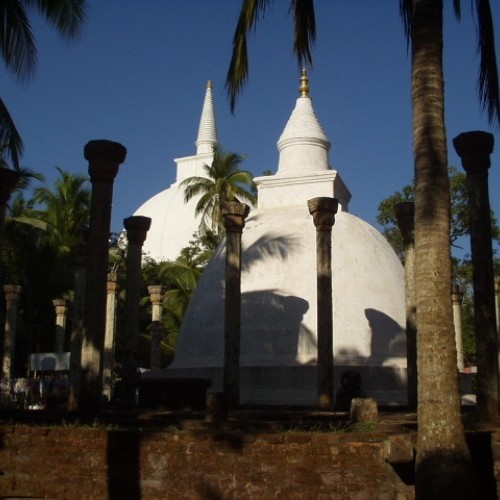
The third flight of steps, narrow and steep, takes you on a spiritual ascent to the highest plateau, where the lovely Ambasthala Dagoba marks the place where Mahinda surprised King Tissa in mid-hunt and quizzed him about mango trees to test his intelligence. The Mango Tree stupa is supposedly built on the exact spot where Mahinda stood, and the statue of the King is placed where he stood, a respectful distance away. The great sage Mahinda preached his first sermon from the Aradhana Gala, the "Rock of Convocation", near here.

From this plateau trails spread out in all directions. One leads to the 1st Century BC Mahaseya dagoba, the largest stupa in Mihintale, which enshrines a single hair relic of the Buddha. Another path wends its way to Mihindu Seya where a small golden reliquary resembling the earliest Indian stupas surmounted by a chattra (umbrella) was discovered, along with a bronze statue.

Above them all towers the enormous boulder that covers Mihindu Guha or "Mahinda's Bed". The bed itself is a smooth slab of stone, the covering rock was the roof. This is where the sage reposed, apparently oblivious to discomfort.

Another path leads past a long pool in the shadow of a large low rock which is carved in low relief with a mythical five-headed cobra. This is the Naga Pokuna, the "Cobra Pool". Naga is supposed to be the guardian of treasure, protector of water and the marker of rain. The carving on this natural rock emphasises its association with water and it is said the naga's tail reaches down to the bottom of the pool. The pond is part of an elaborate irrigation network that connects it with Sinha Pokuna, the "Lion Pool", by means of stone channels, which never runs dry even at the height of a tropical drought. The outstanding lion gargoyle spurts water into a handsome square bath surrounded by a wide step carved with a frieze.