Anuradhapura
Then
Anuradhapura is Sri Lanka's most sacred town and was the greatest
monastic city of the ancient world. From origins as
a settlement in the 6th Century BC, it was made capital
in 377 BC by King Pandukhabhaya (437-367 BC), who started
the great irrigation works on which it depended, and
named it after the constellation Anuradha.
Although the city has remained a symbol of Sinhalese regal power
and of Buddhist orthodoxy, its period as a centre of
real political power had ended by the 12th Century,
though for 500 years before that it had suffered widely
fluctuating fortunes. By the 19th Century it was completely
deserted.
and now
"Rediscovered" in the early 19th Century by Ralph Backhaus,
archaeological research, excavation and restoration
are still ongoing. Since 1980, UNESCO has been financing
the clear up operation around its columns and pagodas,
which were engulfed by the jungle for nearly 1000 years.
In 1988, it was designated a World Heritage Site.
None of Anuradhapura's many buildings, scattered over an
area of 40 sq km, is in its original condition. This
is scarcely surprising since the town was destroyed
and rebuilt many times before finally losing its function
as capital in 1017. Almost all of the ruins left today
are those of monastery buildings.
Set between the walls of its two huge wewa (tanks) of
precious water, Anuradhapura is the site of the longest
sequence of Sinhalese history, spanning 15 centuries of
continuous occupation and dozens of monarchs. Consequently,
Anuradhapura is not to be missed if you are interested
in the historical, cultural, artistic and architectural
heritage of Sri Lanka.
The ruins of the three most important monastery complexes
in the country are to be found here:
Mahavihara, dating back to the time when Buddhism was
introduced to Sri Lanka in the 3rd century BC.
Abhayagiriya, built under Vattagamani (89-77
BC).
Jetavanarama, the largest stupa in Anuradhapura, similar
in scale to the biggest of the Great Pyramids, and the
pet project of King Mahasena (274-301 AD).
Most of the principal sites of interest can be visited
in a half day tour from Anuradhapura.
King Vattagamani Abhaya (89-77 BC) built a new monastery
north of the Citadel area in honour of the monk Mahatissa,
who had helped him regain the throne but had been excluded
from Mahavihara. Mahatissa became abbot of the new monastery,
which housed 500 renegade monks from Mahavihara. The
Uttara Vihara, or Northern Monastery, was later renamed
Abhayagiriya Vihara after the king.
Encompassing an area of 240 hectares, Abhayagiriya
accommodated as many as 7000 monks. Unfortunately,
the chronicle of this monastery has been lost, and Mahavihara,
which produced the Mahavamsa, a historical chronicle
of the period, was understandably silent about its rival.
However, writings by the Chinese traveller/monk Fa Hien
in the 5th Century provide information on the internal
functioning of monastery life and the buildings standing
today bear witness to a rich cultural heritage.
The Abhayagiriya Vihara complex contains the Abhayagiriya
dagoba, the Samadhi Buddha, the Kuttam Pokuna (Twin
Ponds), Mahasena's Palace, and the Ratnaprasada (Gem
Palace).
The dagoba of Abhayagiriya was
enlarged during the reign of Gaja Bahu I
(112-34 AD), so that it had a diameter and height of
100 m, and later restored by Parakramabahu I in the
12th Century. It is the first example of the use of
vahalkada or frontispiece. These masonry blocks, which
lie at the four cardinal points, fulfilled the dual
function of buttresses to balance the mass of bricks
comprising the dagoba and altars for offerings. The
high- and bas-reliefs in gneiss (a metamorphic rock,
similar to granite) are some of the earliest examples
of Sinhalese sculpture.
Today, however, this dagoba is an overgrown ruin, most
of its richly decorated side temples have crumbled away,
although restoration work is in progress. Only the south
side has two remarkable steles of Padmanidhi and Samkanidhi,
the well-nourished companions of Kubera, the Hindu god
of prosperity, who is also the symbol of the north.
This is evidence of the symbiosis of Hindu and Buddhist
religious thought, as well as an example of the adaptation
of Hindu deities to local conditions. Prosperity is
associated with water, which in India usually comes
from the north. In Sri Lanka, however, water is more
plentiful in the south, so that the gods of prosperity
at Abhayagiriya faced the opposite direction.
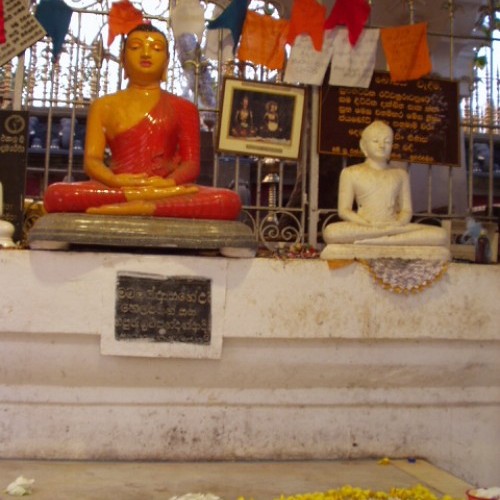
The
Buddha in samadhi (meditation) is a classic example
of early (4th Century) Sinhalese Buddhist statuary.
It was originally one of a group of four statues that
would have been seated around a Bo tree. The whole group
was protected by a dome supported by columns. The surviving
statue is particularly revered and pilgrims hang votive
banners on the grilles which surround it. The weathered
limestone image of the serene Buddha has an expression
depicting "extinction of feeling and compassion",
although the expression apparently changes as the sun's
light moves across the statue's face.
|
Kuttam
Pokuna (Twin Ponds)
|
|
Dug out of the granite bedrock,
the Kuttam Pokuna, or Twin Ponds, were built by two
sovereigns in the 4th and 6th Centuries. There
is no ostentation in the design of the two stepped pools
and yet the effect is impressive. They are not identical
twins, however, as one pond is 12 m longer than the
other, a ratio that is carefully calculated, for this
is the grand classical style which perfect proportions
and restraint make up for the comparative lack of ornament.
The ponds were created for the monks of Abhayagiriya,
who bathed in the water that gushed out of a carved
lion's head after it had passed through a filtration
system, which is still in evidence today. They performed
their ablutions under the protective gaze of a five-headed
cobra believed to bring good fortune.
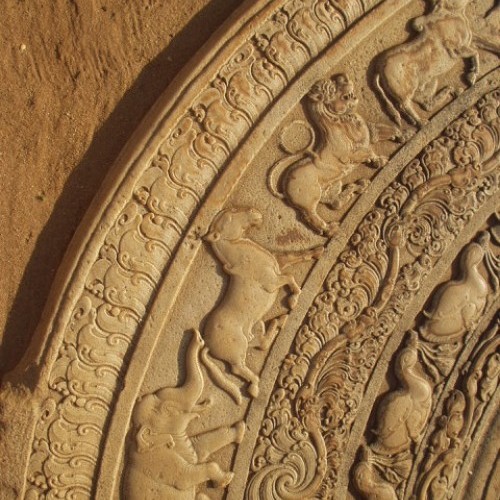
Although only the five rectangular
terraces of King Mahasena's Palace survive today, the
ruins house one of the most beautifully carved moonstones
in Anuradhapura, ornamented in classic Abhayagiriya
tradition.
This
wonderful semi-circular doorstep, originally used to
purify the feet before entering a sacred or royal place,
is elaborately and vibrantly adorned with symbolic carvings.
Its outer band depicts the flames of desire, while the
second band has a sequence of animals - elephant, horse,
lion and bull - repeated three times and concluding
with a further elephant, symbolising human life and
its trials from birth to death. If you overcome these,
as the Buddha did, you achieve the vitality represented
by the climbing plants and leaves in the next band,
and finally become like the geese in the next band,
which have the ability to separate water and milk -
to distinguish between good and evil. If you are able
to overcome the next decorated band, which represents
enlightenment, you come to the lotus at the centre,
a symbol of nirvana.
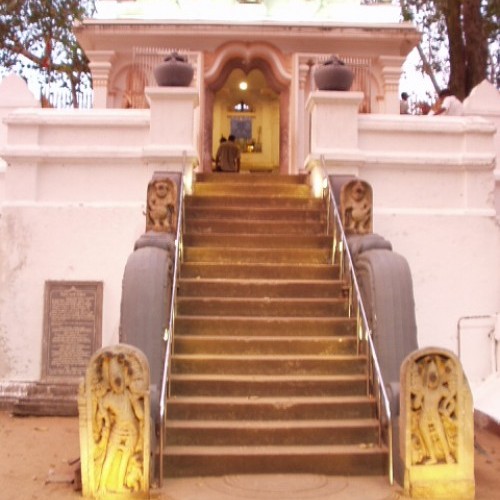
The
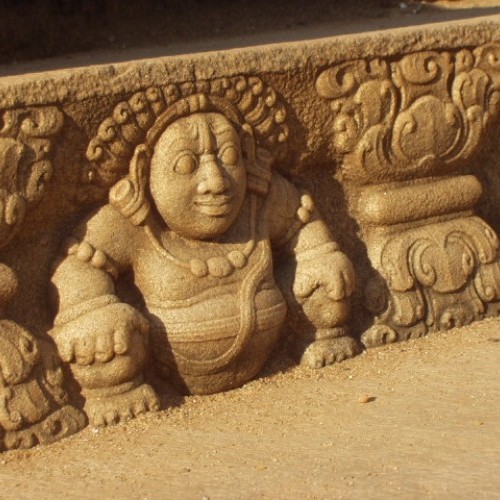
flight of steps above the moonstone are decorated with
dwarves, while the entrance to the image house is flanked
by Padmanidhi and Samkanidhi, the companions of Kubera,
the Hindu god of prosperity, and two Sinhalese lions.
|
Ratnaprasada
(Gem Palace)
|
|
The Ratnaprasada, or Gem Palace,
was the chapter house of the monastery. To protect their
wealth, the monks placed a guardstone at the entrance,
which is the finest in Sri Lanka. The bejewelled figure
is a nagaraja or Cobra King, with a seven-headed cobra
forming a hood over his elaborate crown. Every detail
of his dress is beautifully depicted, with every belt
and tassel clearly defined and miraculously well preserved.
His body is caught in an exaggerated, elegant posture
and the feet touch the ground lightly. He is proffering
the symbols of prosperity - a purna ghara or "pot of
plenty", the Sri Lankan equivalent of a cornucopia and
a flowering branch. Above his head is an arch depicting
makaras, dragon-like mythical creatures, either consuming
or regurgitating a ribbon of history. Good fortune is
represented by a writhing mass of naked dwarves and
fruit. At the foot of the nagaraja is an attendant dwarf,
or gana, who seems to be chortling at the bacchanalian
scene.
Jetavanarama is the largest complete dagoba in the world, towering
some 120 m over all the other buildings in the city and
is contained within a perimeter wall enclosing 3 hectares
of land. The last of the great monasteries to be built
in the capital, it took 24 years and 10 million bricks
to build. The dome is still intact but overgrown and is
currently being restored. Amongst other relics, the dagoba
contains the alms bowl and belt of the Buddha.
The
complex was the vision of King Mahasena, who was also
responsible for the construction of the largest tank,
Minneriya. The design of Jetavanarama follows in the
footsteps of the Abhayagiriya dagoba by having vahalkadas
(frontispieces), built at each of the four cardinal
points. Jetavanarama's eastern vahalkada was decorated
with beautiful figures of alluring women posed so elegantly
they appear to be moving or dancing, wearing elaborate
but scanty attire.
The monastery district is located mainly to the west
and south of the impressive dagoba and includes the
remains of some impressive buildings. Among these are
the image house with the imposing door frame opening
to the east. It has lost its Buddha figure, but the
lotus throne has been restored. A deep opening beneath
the throne reveals a huge garbhagrha, a type of case
for various relics, indicating that this was the most
sacred place in the building.
South of this are most of the panchakavasa, rectangular
accommodation units each with four kuti (monk's dwellings)
and a central meditation room. The monastery also had
a system of pipes to supply the monks with a hot bath.
A good example of simulated wood construction techniques
in stone edifices is a Buddhist fence in the southern
part of the grounds. Adjacent to this on the east are
the chapter house and refectory.
The
Mahavihara and its sister monastery, Cetiyapabbata, in
the Mihintale hills reigned for a long time over monastic
life of the island. In 89 BC, this hegemony wavered with
the foundation of a new monastery, Abhayagiriya. The rivalry
between the two establishments was such that it was ended
by setting down Buddhist law in writing at Aluvihara near
Matale. During the reign of Mahasena, Abhayagiriya triumphed
and the king dissolved Mahavihara and built a third monastery,
Jetavanarama, with the rubble. The old monastic establishment
was finally taken over by Mahasena's successor, but the
rift between Mahavihara and Abhayagiriya lasted more than
1000 years, until Parakramabahu reconciled them in the
13th Century.
The Mahavihara complex contains the Sri Maha Bodhi
(sacred Bo tree), the Thuparama dagoba, the Loha Pasada
("Brazen Palace"), and the Ruvanveliseya dagoba.
|
Sri
Maha Bodhi (Sacred Bo tree)
|
|
Immediately
after his conversion by the Buddhist monk, Mahinda,
Devanampiya Tissa (250-210 BC) built a temple of the
sacred Bo tree, the Sri Maha Bodhi, which was probably
located in his own royal garden. From here, the king
laid out a procession route across his garden to the
Thuparama dagoba. The cutting from the fig tree under
which the Buddha attained enlightenment was brought
to this special place by Sanghamitta, the daughter of
the great Indian emperor, Asoka, and sister of Mahinda.
Today,
all that is left of the original temple is the platform
bearing the tree and parts of the surrounding wall.
The smaller temples, moonstones, guardstones and makara
balustrades are all later additions. You can only see
the top of the Bo tree, which is supported by an elaborate
metal structure and is surrounded by brass railings.
These are bedecked with colourful prayer flags and smaller
votive offerings which pilgrims tie in expectation of
prayers being answered. Picking up, let alone plucking
leaves from the sacred Bo tree is strictly forbidden.
At the entrance to the temple, a large panel displays
the warning given by Mahinda to King Devanampiya Tissa:
"Sire, the birds that soar in the sky and the animals
that roam in the jungle have an equal right to live
and go where they wish in this country. Also, your domain
is primarily the domain of the people and all the creatures
that live in it. You are merely the administrator"
Sri
Maha Bodhi, or the Temple of the Great Enlightenment,
is still one of the holiest sites on the island, for
both Buddhists and Hindus, and the original Bo tree
(Ficus religiosa) growing in the temple precincts is
the oldest recorded living tree in the world. Together
with the cult of relics, the tree cult is the most ancient
manifestation of Buddhist worship, during times when
any representation of the Buddha was taboo. In context,
the Indian fig evokes for the devotee the Enlightenment,
the Bodhi, which is the attainment of the state of the
Buddha.
Founded in 276 BC to house the
right clavicle (collar-bone) of the Buddha, the Thuparama
dagoba is the oldest reliquary monument in Anuradhapura,
even though nothing of the original structure remains
standing. What
you see today is not ancient at all, but a reconstruction
of the mid-19th Century. The dagoba is not even the
right shape since the original resembled a heap of rice,
rather than the present bell-shaped form. The concentric
circles of granite columns surrounding the dagoba were
added in the 7th Century, possibly originally designed
to support an over-arching thatched roof. This is the
prototype of a Buddhist monument that is only found
in Sri Lanka - the thupaghara, the "stupa house", called
vatadage in Sinhalese. Beside the staircase leading
to the square, guarded by two cobra-kings, a pool enables
the many pilgrims to wash flowers they have brought
as offerings.
|
Loha
Pasada ("Brazen Palace")
|
|
According
to chronicles, King Dutthagamenu (161-137 BC) built
a residence of nine storeys, each with 100 rooms, the
roof of which was covered with copper tiles, hence the
name "Brazen Palace". Despite its name it was not a
royal palace but a residence for monks. Sadly it was
destroyed by fire only 15 years after completion. Subsequent
reconstructions never rivalled the original building's
dimensions or grandeur. When, in the 3rd Century,
serious conflict arose between Mahavihara and Abhayagiriya
and the monks of the Mahavihara were forced to flee,
their opponents used the Brazen Palace as a quarry.
The short stone pillars, most of them rough-hewn and
all tilting at varying angles, you see today are all
that remains of the work completed by King Parakramabahu
in the 12th Century. Although they were only gathered
together and set upright again a few years ago - this
is why they differ in style - the columns spread over
an area of 2500 m² give a good idea of the dimensions
of the original monastery building.
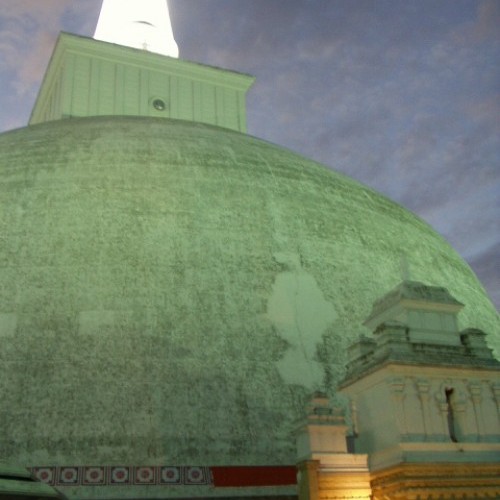
The Ruvanveliseya dagoba, also
known as Maha Thupa or Great Stupa, was begun by King
Dutthagamenu to house relics and it is the most revered
of the dagobas in the holy city. Priests
from all over India were recorded as being present at
the enshrinement of the relics in 140 BC.The huge dome
is 80 m in diameter at its base and 53 m high. Every
four years the dome is whitewashed by painters abseiling
down the length of the structure. At the four cardinal
points are "chapels", which were reconstructed in 1873
when renovation began. The paving of the square surrounding
the dome is punctuated with padapittika, slabs decorated
with a pair of footprints marking the places for practising
meditation. Pilgrims and monks can often be seen motionless
and meditating in silence on the square. This is particularly
atmospheric in the early evening when the mantras begin
and the dome is illuminated with iridescent blue light.
An
army of full-size sculpted elephants, which were once
fitted out with real tusks, standing ear to ear along
the whitewashed perimeter wall, surrounds the dagoba.
This elephant wall has an imposing effect, but its function
is also symbolic. The elephants seem to support the
platform of the dagoba, just as in Buddhist mythology
they hold up the earth. This symbolism is continued
in every detail of the dagoba. The dome represents heaven
or, alternatively, the head of the Buddha. The conical
spire is an elaborate accumulation of chatras, parasols
that indicate kingship. They may also remind you of
the protuberance appearing from the head of the Buddha,
which signifies super-enlightenment.
|