Aluvihara
Temple of the Ashes
Then…
Aluvihara, the Temple of the Ashes, has great significance for the Buddhist world as it was here that the Buddhist Doctrine was first written down in Pali on ola leaves in the 1st Century BC during the 4th Buddhist Council.
Previous to this time the Buddhist Doctrine or Tripitaka ("Three Baskets") was handed down orally, since the Buddha had left nothing written down. The preservation of the doctrine was therefore initially entrusted to the memory of his disciples, who had listened to him, but the sanctity of the Buddha's teachings needed a more structured approach and consequently the 1st Buddhist Council was established in the 6th Century BC. However, depleting ranks, infighting between the great monasteries of Mahavihara and Abhayagiriya in Anuradhapura, and the hazards of sickness and death convinced the Buddhist sangha (order of monks) that the practice of preserving the Buddhist Canon and its commentaries through oral transmission had to be rethought. In 88 BC, the monks assembled at Aluvihara near Matale and committed all the texts to writing.
…and now
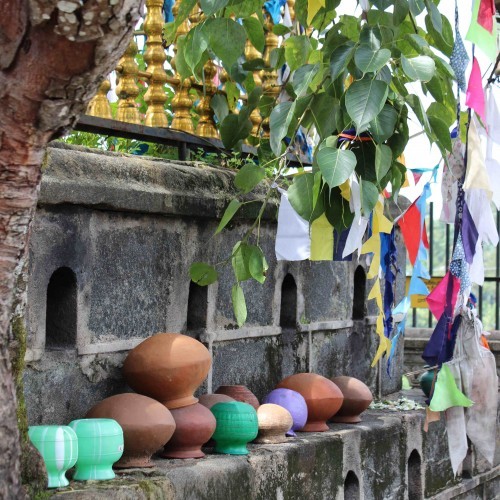
Today, Aluvihara is a complex of cave temples, each with different functions and contrasting moods, and a monastery with a scriptorium. Several of the caves are beautifully painted with frescoes, one contains a large reclining Buddha, also brightly painted, and one is dedicated to the Indian scholar Buddhagosa. The strangest of all contains a salutary depiction of the afterlife awaiting miscreants. As your eyes adjust to the gloom you will see colourful statues of sinners being punished by demons, such as an unfaithful woman being chopped into pieces, and a male sex-pest having the top of his skull removed so that the demons can reach in with a spoon and ladle out his brain!
Why visit Aluvihara?
Even though the original library of priceless manuscripts dating back to 88 BC and the lifetime's labour of 500 monks was destroyed by fire in 1848 when the British quelled a revolt by the monks of Dambulla, the site retains a certain spirituality and mysticism of its own, particularly after you have visited the temple's "chamber of horrors"! In addition, the laborious task of replacing the library has been painstakingly carried out since their destruction, with the first of the "Three Baskets" of the Tripitaka being completed in 1982. The monks reconstructing the library can be seen in a scriptorium at Aluvihara producing facsimiles of the originals on the long leaves of the ola palm, which are then loosely bound to make books.
Most of the principal sites of interest can be visited in a 1-hour tour on the way from either Kandy or Dambulla.
Trip Planner